Thursday, September 28, 2017

Trump Backs the Democrats’ Debt Limit

In what had to be Mitch McConnell’s and Paul Ryan’s worst Trump experience – and there have been numerous low points – they had to sit and listen as President Trump, after some discussion, decided to support Chuck Schumer’s and Nancy Pelosi’s three-month debt ceiling extension with hurricane funding and a continuing resolution.

Republicans felt blindsided by a bad deal, but Trump was joyous over having struck a deal and effusive in his praise of the two Democrats without mentioning the Republican leadership.

President Donald Trump speaks to (L to R) Senate Majority Leader Mitch
McConnell, Senate Minority leader Chuck Schumer and House Minority
Leader Nancy Pelosi in the Oval Office, Sept. 6, 2017 | Evan Vucci/AP

It demonstrates:
  • Trump is desperate for some legislative action that will be judged as progress.
  • He has no rapport with the Republican Hill leadership. In fact, tweaking them is pleasant and fires up the base
  • Republicans’ internal fights over entitlements, debt and deficits are of little interest to him. He wanted health care as an accomplishment and really believes tax cuts will be a legacy item, but the fiscal issues are inside baseball.
  • The optics was perfect for Trump. He’s in the Oval Office (his studio), the parties are asking for his decision and he pulls a surprise. Top ratings.

Senate Minority Leader Chuck Schumer (L) and President Donald
Trump in the Oval Office, Sept. 6, 2017 | Alex Wong/Getty Images
Expect more effort to strike bargains with Democrats if Republicans can’t settle their differences and unit behind a position.

Trump’s Slippage Continues

The Orange County Register resident conservative/libertarian public intellectual Joel Kotkin just called for the removal of Donald Trump in spite of his usefulness in bringing disruption to a deadlock and progressively dominated D.C. establishment. Or as Kotkin put it:
“The great disrupter is rapidly becoming a great disaster – for the country, his party and even his own political base. In order to save anything from his landmark 2016 victory, President Donald Trump must go – the sooner, the better.” (Sept. 3, 2017)
Trump is increasingly losing his party and the American people based on his ill-disciplined behavior and venomous attacks – his general lack of character. Kotkin may be ahead of the Republicans that have been Trump’s hardcore base due to preferring his policies, but they appear to be moving in his direction.

August was a devastating month for President Trump. The latest Fox News poll has 56 percent of the public believing he is “tearing the country apart.” And a new Pew Research poll shows Trump losing nearly two-thirds of Republican (64% “don’t like” or “mixed feelings”) support due to his character.

Trump is now beyond six months into his presidency. The start-up excuses are waning. Winter is coming.

Charlottesville Changed the Trump Presidency – 9News, Kim Christensen

Tragedy often changes a president’s policies and politics. President Bush became a war president after 9/11 and never entirely recovered from the onslaught of Hurricane Katrina and its blow to New Orleans. President Trump is currently dealing with Hurricane Harvey and the Texas coast, but the August 12 violence in Charlottesville, Virginia, and his subsequent press conference are still affecting his public image, his relationship with fellow Republicans and the corporate leadership he had recruited to serve on various White House councils.

In a 9KUSA interview on Wednesday, August 16, with Kim Christensen at the 4:00 pm news, what a teacher would tell high school or college students was discussed. Some points made were:
  • Although we’ve had a black president for eight years, anti-Semitic, KKK and neo-Nazi views are not new and appear repeatedly in American politics.
  • America has been undergoing rapid change, there is a lack of trust in institutions, and deep divisions based on party and political beliefs.
  • That the American political creed requires respect for unpopular views so it’s important to have skills at non-violent debates with people who a person disagrees with.
  • Many students are not familiar with the basic tenets of American democracy that allows majority rule, but protects minority rights.
  • American people overwhelmingly reject neo-Nazi and White Supremacist views (83% unacceptable).


Polls subsequent to the Charlottesville event and Trump’s handling of it.

In a PBS NewsHour, NPR/Marist poll of August 14-15, 2017, 52 percent of respondents think Trump didn’t issue a “strong enough” statement on the violence in Charlottesville. An early Washington Post-ABC News poll (Aug. 16-20, 2017) agreed and showed disapproval of President Trump by two-to-one (56% to 28%). But in the earlier NPR poll, 62 percent believed statues of confederate leaders should “remain as historical symbols” vs. “removed as offensive” (27%). Also, many Republicans tend to believe there is “a lot of discrimination against” white people (42%) and Christians (48%).


This became a moment when Americans and citizens around the world would expect the U.S. president to act as the sovereign, the symbolic head of state, and condemn evil and call for unity and healing.

Trump tried, but mostly his reaction was as the head of Trump Nation, something between offering color commentary of the events and a defender of what he believed were “good people”; i.e., protectors of confederate statues. It was a poor choice of roles and disastrous timing. He paid dearly. In a Pew Research poll at the end after event of August 15, Donald Trump was judged harshly for his conduct as president, even by Republicans who have been faithfully approving of his presidency, especially on issues. More than half of the public (58%) don’t like his conduct and almost two-thirds of Republicans (65%) now have either mixed feelings or don’t like his conduct.


Hickenlooper and Kasich Offer Bipartisan Health Care Plan – Susan Witkin, KOA


“Goddammit, I’d piss on a spark plug if I thought it’d do any good!”
(General Beringer, WarGames, 1983)

The American people are so desperate for breaking the gridlock in Washington and making some progress on health care that they will welcome the improbable plan of Governors Hickenlooper and Kasich. In a Friday, September 1 interview with KOA’s Susan Witkin, we discussed the politics of the initiative.


The Hickenlooper/Kasich (with six other governors) got very strong coverage over Labor Day weekend. They sent a letter to Congress and will testify before the Senate Health Care Committee on September 7. Of course, as can be expected with any bipartisan effort, the right and left immediately attacked it as too little or too much (not repeal - right, not single-payer – left). But the governors labeled it as a pragmatic first step presented by the executives who will be held most responsible by voters if the current system simply collapses next year.

Can bipartisanship actually gain some traction? There are at least a handful of senators that would support a stop-gap measure and more than 40 House members of the Problem Solvers Caucus who had their own bipartisan plan issued last July. But legislative leadership is differential to the extremes in their respective camps and the congressional process is cumbersome and can be derailed.

Both Kasich and Hickenlooper are ambitious and want to be part of the national conversation on how to break the gridlock (and possibly move on to a new job). It remains difficult to see how either one of them can affect their respective parties, but there is clearly a vacuum, which they are enjoying trying to fill.

See The Buzz: Country ready for an independent?

Country Ready for an Independent?

Democratic Colorado Gov. John Hickenlooper and Republican
 Ohio Gov.  John Kasich at a news conference in Washington, 
June 27, 2017 | Getty Images.
John Kasich and John Hickenlooper have mused the moment might be right for an independent ticket for president and vice president. Of course, they offer the usual denials that they are not serious, but they do have several things working for them. Both parties delivered their nominations to very unattractive candidates leaving huge swaths of voters making their least unfavorable choice. Donald Trump’s insurgent takeover of the Republican Party and Bernie Sanders nearly capturing the Democratic nomination shows how vulnerable the parties are to movements and ideas outside their respective establishments and orthodoxies.

Considering 2020, the Republican Party remains fractured by Trump’s self-regard and character flaws as much as any policy differences. But the Democrats continue to appear befuddled locating an attractive governing philosophy beyond opposing Trump, a strategy that did serve them sufficiently in 2016.

But as weak as the parties have become, the opening for a bipartisan team of two moderate governors to run as independents is still very narrow.

Power of Partisanship
America’s two-party system still represents at least 60 percent of the electorate and voters tend to remain loyal. Trump would have a 25 percent approval rating from his core supporters if regular Republicans weren’t still on board. And, although he eked out his thin victory with the white working class in several states, in fact, he carried upwards of 90 percent of rank and file Republicans.

But beyond voter loyalty to overcome, the parties have embedded themselves in state statutes, making ballot access and conducting third-party campaigns very onerous.

Money
Massive amounts of money will be needed to get on the ballot in most states and to run a campaign. Neither Kasich nor Hickenlooper are rich or such high-profile celebrities to get around the $1 billion minimum that appears to be required to both promote a candidacy and to defend against the inevitable attacks.

Democrats
Hickenlooper, in particular, will be considered by Democrats as a spoiler. The Party is convinced Trump is likely a one-termer and will not want a moderate independent/Democrat in the field that could siphon Democratic votes from the ticket.

Moderation
This appears to be a moment the public is interested in politicians who lower the drama and extreme partisanship to get things done. But, the centrist approach that often wins for state executives may not motivate the wider reaches of national party voters or even independents.

The good news for the two of them is that the moment appears right to offer some can-do bipartisanship. All the legacy media is ready for a contrast to Trump, the Freedom Caucus, Nancy Pelosi and Bernie Sanders. At a minimum, Kasich and Hickenlooper should have fun ride on the talk shows.

Interview with Erica Meltzer for the Denverite, an online newsletter:

Longtime Colorado pollster Floyd Ciruli said this frustrating coyness is “a common Colorado trait of politicians who are nationally ambitious.”

“The history is that for a very long time, as soon as you talk about national ambitions, you get into local trouble,” he said. “They say, ‘you’re not paying attention to us,’ and everything gets judged by their national ambitions.”

So all those denials are really confirmations?

“He’s absolutely interested, but he’s realistic,” Ciruli said of Hickenlooper. “This would be the longest of long shots, but at the moment, this is a really interesting perspective in terms of partisanship and gridlock and moving past that.”

. . .

Ciruli said the fact that this ticket is being talked about at all reflects the political moment we’re in, one where both parties produced candidates that were broadly unpopular in the last general election and there is widespread disgust with gridlock in Congress and intense partisanship.

“It’s the best alternative theme out there,” he said.

. . .

Ciruli said the more likely third-party candidate would be someone very rich and capable of self-financing a national run — someone like Facebook founder Mark Zuckerberg, whose recent tour of the country complete with many social media posts with “real Americans” raised speculation, or former New York Mayor Michael Bloomberg — not “a couple of well-intentioned politicians.”

. . .

If nothing else, this speculation raises the profile of the governors’ brands.

“Good for them,” Ciruli said. “They’ll make a lot of talk shows.”

War With North Korea and Presidential Trust

President Trump doesn’t make it easy for the majority of Americans to support his direction on North Korea.

  • A majority of the public prefers negotiation to threats of military action with North Korea (59%)
  • Most experts believe war would be “catastrophic” (Mattis, 8-10-17)
  • Americans would support military action of diplomacy failed
  • Trump’s rhetoric has been full of bellicose slogans: “fire and fury” and “locked and loaded”
  • Much of the administration’s foreign policy leadership (Mattis, Dunford, Tillerson, McMaster) put Trump’s comments into a more diplomatic context

The bottom line is that more than half the public (59%) is uneasy about Trump’s “ability to handle the North Korean nuclear situation” (CBS News poll, Aug. 14-16, 2017).

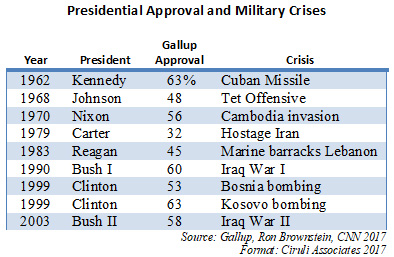
And, of course, more than half the public (56%, RealClearPolitics average) disapprove of President Trump’s presidency as of mid-August and only 38 percent approve. He would be the weakest president in terms of approval at the start of a crisis involving military action since Carter (32% approval) in 1979 at the beginning of the Iranian hostage crisis.


Trump has the advantage that most Americans rate North Korea as a serious threat, and know that previous diplomatic efforts have failed. But, Trump has to construct support for his approach from a very skeptical public.

Trump

“Fire and fury” – 8-10, Any further threat met with fire and fury (tweet)

“Maybe wasn’t tough enough” – 8-11, “They’ve been doing this to our country for a long time, for many years, and it’s about time that somebody stuck up for the people of this country and for the people of other countries. So, if anything, maybe that statement wasn’t tough enough.”

“Locked and loaded” – 8-11, “Military solutions are now fully in place, locked and loaded, should North Korea act unwisely. Hopefully Kim Jong Un will find another path! He has disrespected our country greatly. He has said things that are horrific. And with me he’s not getting away with it. This is a whole new ballgame.”

Mattis – 8-10, “My portfolio, my mission, my responsibility, is to have military options should they be needed. You can see the American effort is diplomatically led. It has diplomatic traction. It is gaining diplomatic results. And I want to stay right there right now. The tragedy of war is well enough know; it doesn’t need another characterization, beyond the fact that it would be catastrophic.”

Wednesday, September 27, 2017

In Age of Disruption, Governing is Tough

Although European establishment politicians hold power in France, Germany and Great Britain, they are struggling with leading the change the era and major segments of the public demand.

Prime Minister Theresa May was to bring a firm hand to the Brexit process, but lost an election to strengthen her majority and now only has the approval of a third of the public. She faces an unhappy right, an energized left and ever threatening secession sentiments.

President Emmanuel Macron swept into office extoling the EU and internationalism, while crushing the far right. But he shares with May the approval of only a third of the public. Budget cuts required by EU rules have alienated his military and his own style, criticized as imperial, has taken a toll.

Chancellor Angela Merkel continues to lead the Western leaders with more than half of the public’s support. She will likely win re-election. But, her approval has fluctuated and dropped recently as her re-election campaign deals with criticism from the left.

President Vladimir Putin’s 2018 election is in the bag, but he works public opinion like a pro, with a sophisticated propaganda machine, aggressive restraint of opposition and use of foreign policy for fueling nationalistic sentiment. He lets his prime minister take the blame for any weaknesses in domestic policy. His approval rating is in the 80s. Medvedev’s is usually well below the 50s.

President Donald Trump has been in office about 220 days, won office with 46 percent of the public and has never moved above that figure. Today, his approval is often measured below 40 percent.

The politics of the era of disruption is driven by the deep loss of trust in the government and major institutions, including national parties and its leaders, and the broad polarization among significant segments of the public, reinforced by the new technologies of communication; i.e., cable news, social media.

If you prefer a liberal democratic order and a free market, don’t expect it to survive without leaders and a public ready to fight for it.